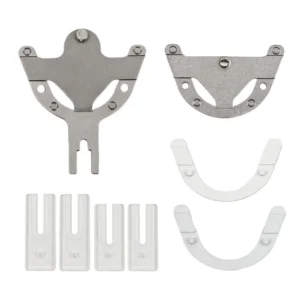


Adjustable Dental Hinge Articulator
Although this cost-effective hinge articulator features a simple design, it empowers dentists and technicians with versatile jaw movements, including protrusion and lateral adjustments. This functionality ensures the precise fabrication of prostheses with accurate anatomy and optimal occlusion.
Flexible adjustment function on articulator
1. Incisal Guide Adjustment (Incisal Screw)
- Mechanism: The device features a vertical threaded screw with a knurled knob (the incisal screw/pin).
- Function: By rotating the incisal screw, dentists and technicians can vertically adjust the maxillary jaw model. This allows the upper model to be moved (often in a negative or downward direction) to precisely align with the mandibular model. This adjustment is critical for establishing the correct occlusion position (bite) between the upper and lower jaws.
2. Maxillary Protrusion, Lateral Adjustment (Spring Mechanism)
- Mechanism: The articulator incorporates a spring mechanism (visible as the coiled spring in the center hinge area in the second image).
- Function: This spring mechanism enables the adjustment of maxillary protrusion, and lateral movement. It allows the maxillary (upper) component to simulate forward movements, helping to replicate the natural protrusive range of the patient’s jaw.